Congratulations to all whose papers/abstracts have been accepted.
Call for Submissions
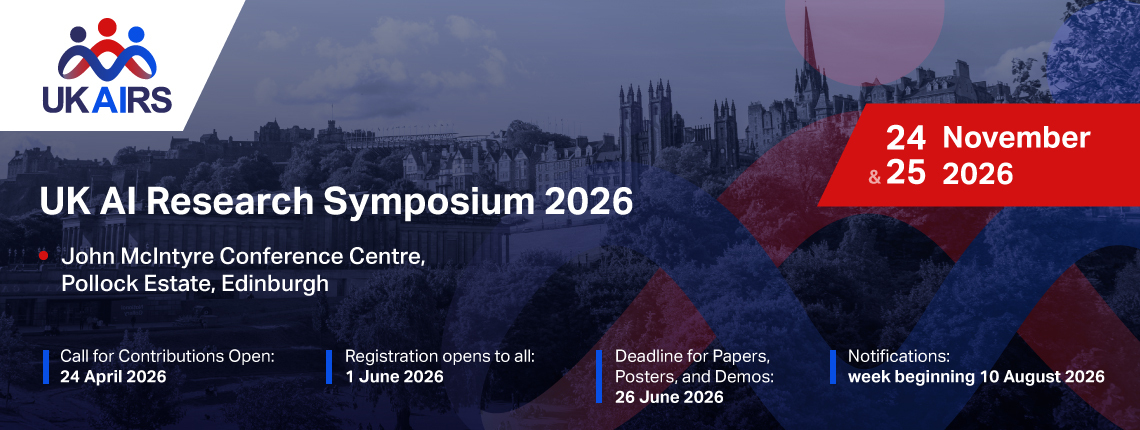
Deadline: Submit by 23:59 on Friday, 26 June 2026
Eligibility
Students and researchers from institutions who have received or are eligible for UKRI AI investments (eg. all UK Universities) can submit under the World Class Research Track (already published conference or journal paper to present on) and/or Emerging Research Track (abstract for poster).
Background
The UK AI research community plays a key role on the global stage in advancing fundamental research in artificial intelligence while having unique strengths in interdisciplinary research that fuels novel applications and industries, as well as shaping AI policy and regulation. To support the community, over the last 6 years UKRI has invested in large research programmes including the AI Hubs and AI CDTs as well as in key parts of the AI research ecosystem such as the Turing Institute, Responsible AI UK, BRAID, the TAS Programme, and Bridge AI.
This community is made up of researchers from diverse backgrounds and disciplines that share a number of similar research challenges or overlap in terms of the problem areas they address. UKAIRS will showcase the very best of the research (including already published outputs) funded by UKRI whilst also providing a platform for UK AI researchers, at all career stages, to discuss emerging challenges and inform the wider community of industry, government, and civil society.
Purpose
UKAIRS aims to bring students and researchers from institutions eligible for UKRI funding (including, e.g., any PhD student or staff member affiliated with a UK Universities). The goal is to shape the UK’s research priorities, identify cross-fertilisation opportunities, and inform the narrative around the challenges to delivering AI that benefits society and the economy. UKAIRS will invite research contributions through research abstracts and posters.
This year we invite contributions from any researchers, students, and practitioners affiliated with research organisations eligible for UKRI funding, including overseas institutions. We particularly encourage contributions from early career researchers. Contributions can be papers already published at other venues, provocations, posters, and journals (see formats below).
Subject Areas and Review Process
UKAIRS invites researchers, students, and practitioners to submit the following types of contributions. The review process is covered in italics:
01 World Class Research Track (already published conference or journal paper for a presentation slot): You will submit your peer-reviewed and published work, which can be the original published journal or conference paper.
02 Emerging Research (2 pages for a poster session slot): Research and early-stage research. REVIEW: peer review by up to 2 reviewers. References can be on an additional page to the 2 main pages.
Submissions should fall into one of the following themes and research topics:
|
Track A
Natural & Physical Sciences
Lead: Dr. José Miguel Hernández-Lobato
|
Track B
Life & Health
Lead: Dr. Indu Bodala
|
|
Track C
Algorithms, Agents & Theory
Lead: Dr. Yali Du
|
Track D
Engineering & Manufacturing
Lead: Prof. Vihar Georgiev
|
|
Track E
Sustainability & AI
Lead: Prof. Margaret Graham
|
Track F
Synergistic Human-AI Collaboration
Lead: Dr. Matt Roach
|
Please indicate on your submission which theme and research topic your work falls under.
Submission process
All submissions will proceed through the following process. Please contact the Papers chairs if you have any questions.
01 Preparing your submission: papers and abstracts must be in English and in PDF format; and include figures, tables, proofs, appendixes, and any other content.
02 World Class Research Track submissions should be the original published journal or conference paper, making sure the submissions contains the publication details.(For example, in case of a journal, the pdf should contain the journal name, issue, year, etc.)
03 Emerging research/provocations should comprise 2 pages. For more information about the paper templates, including downloading the LaTeX or Word templates. Please use the 2-column template (\documentclass[sigconf]{acmart}) which can be found here.
04 Submitting your contribution: Include your title, abstract, author details, and the contribution as a PDF. We ask you to ensure your submission is accessible for all users. To accomplish this, please follow the SIGCHI Guide to an Accessible Submission.
Presenting your work Papers.
Authors of accepted papers will be invited to present their paper at UKAIRS (typically 10 min talk).
Emerging Research Submissions: Accepted submissions will be given the opportunity to present a poster.
We strongly encourage authors to consider the accessibility of their abstracts and presentations, such as by including figure descriptions. Please consider the EPSRC guidance for neuro-inclusive meetings and events. If you have any questions about creating accessible submissions, please contact us.
LLM Statement
We are following the ACM guidelines on the use of Large Language Models (LLMs) in authoring papers. This means that any text generation from an LLM such as ChatGPT must be clearly marked where such tools are used for purposes beyond editing the author’s own text. While we will not use tools to detect text generated by LLMs, we will investigate submissions brought to our attention and will desk reject papers where LLM use is not clearly marked. We recommend that authors read the ACM Policy on Authorship and related SIGCHI blog post.